
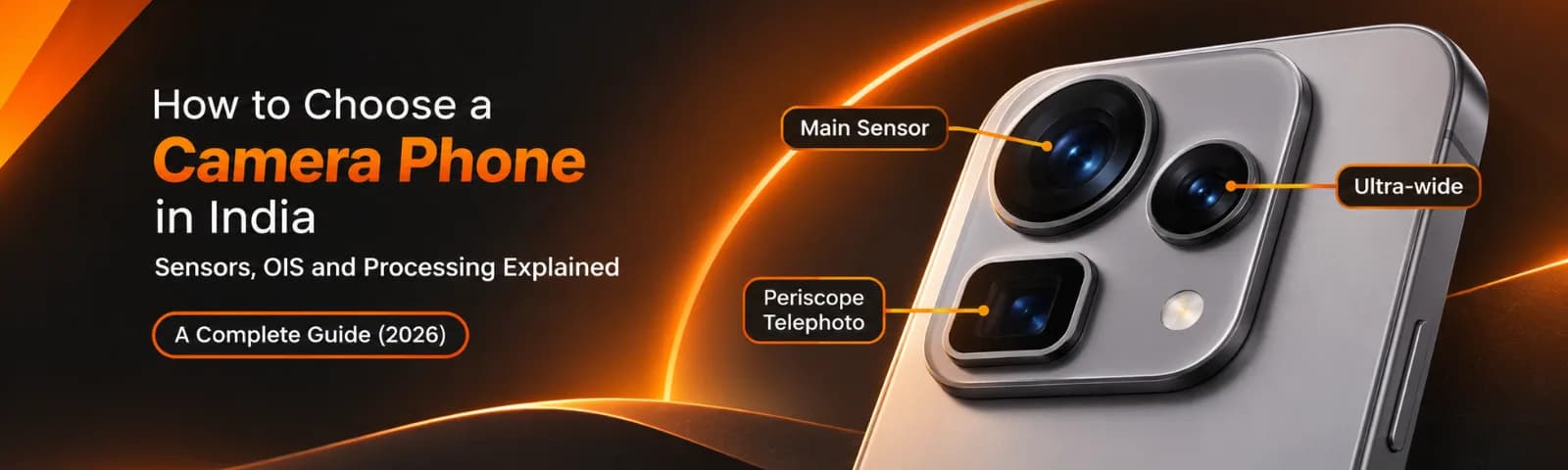
To choose a camera phone in India, check four things in this order: the main sensor's size, whether the main camera has OIS, whether there is a real optical telephoto, and how good the phone's image processing is. Megapixels and the number of lenses matter far less than most spec sheets suggest.
Key takeaways
- A bigger main sensor (1/1.56-inch or larger) gathers more light and gives cleaner low-light photos than a smaller one.
- OIS on the main camera is the single most useful feature for night photos and steady video.
- A periscope telephoto gives true 3x to 5x optical zoom; "100x" figures are digital zoom.
- 2MP macro and depth cameras add almost nothing; a good ultrawide matters more.
How to choose a camera phone: the 4-step checklist
- Find the main sensor's name and size. Look for a named sensor (for example, Sony LYT-600) and a size such as 1/1.95-inch.
- Confirm OIS on the main camera. Skip phones that only have EIS if you shoot at night or record a lot of video.
- Check the zoom camera. Prefer an optical telephoto or periscope over a 2MP macro or depth lens.
- Check video and selfie. Look for rear 4K at 60fps and an autofocus front camera.
Camera sensor size: the spec that matters most
Sensor size matters more than megapixels because a larger sensor collects more light, which means less noise and better detail in low light.
- Sizes like "1/1.56-inch" come from an old TV camera tube convention and are not real measurements; DXOMARK and Imaging Resource both note that a "1-inch type" sensor is only about 16mm diagonally.
- A smaller number after the slash means a bigger sensor: 1/1.3-inch is bigger than 1/1.56-inch, which is bigger than 1/1.95-inch.
- Megapixels are not the same as quality: Samsung's 200MP ISOCELL HP3 uses 0.56-micron pixels and combines them 16-in-1 to output 12.5MP photos with more light per pixel.
Common camera sensors in 2026 phones
| Sensor | Resolution | Size | Where you find it |
|---|---|---|---|
| Sony LYT-600 | 50MP | 1/1.95-inch | Mid-range main cameras, some periscopes |
| Sony IMX882 | 50MP | 1/1.95-inch | Mid-range main cameras and periscopes |
| Sony LYT-700C | 50MP | 1/1.56-inch | Upper mid-range main cameras |
| Samsung ISOCELL HP3 | 200MP | 1/1.4-inch | High-resolution main cameras |
| Sony LYT-828 | 50MP | 1/1.28-inch | Flagships such as the vivo X300 Pro and OPPO Find X9 Pro |
| Sony LYT-900 | 50MP | 1-inch type | Top camera flagships |
What is OIS in a camera, and OIS vs EIS
OIS (optical image stabilisation) uses a gyroscope and a small motor to move the lens against your hand's shake, so photos stay sharp when the shutter stays open longer in low light.
- EIS (electronic image stabilisation) is software: it crops into the video frame to cancel shake. It needs no extra hardware, so it is common on budget phones.
- OIS vs EIS: OIS helps both photos and video; EIS helps mainly video. Phones that combine both give the steadiest results.
- Sensor-shift OIS moves the sensor instead of the lens. Apple first used it on the iPhone 12 Pro Max.
Telephoto and periscope camera phones: real zoom vs digital zoom
A telephoto camera gives true optical zoom, while "digital zoom" only crops and enlarges the image, losing detail.
- A standard telephoto fits about 2x to 3x zoom inside a phone's thickness.
- A periscope telephoto uses a prism to turn light sideways, so it can fit 3x to 10x optical zoom in a slim phone.
- Figures such as "up to 100x" on spec sheets are digital or hybrid zoom, not optical.
Periscopes are no longer flagship-only. The Nothing Phone (4a) launched in India in March 2026 at Rs 31,999 with a 3.5x periscope, and the vivo V70 launched in February 2026 at Rs 45,999 with a 3x periscope. Prices have changed since launch, so see our best camera phone under 40000 guide for current picks.
Ultrawide and macro cameras: what to ignore
A good ultrawide is worth having, but 2MP macro and depth cameras add almost nothing to photo quality.
- 2MP macro cameras have too little resolution for crisp shots; Digital Trends and Notebookcheck both call them spec-sheet filler.
- Most Rs 30,000 to Rs 45,000 phones still use 8MP ultrawides, which look softer than the main camera.
- Flagships such as the iPhone 17 Pro, Pixel 10 Pro and Galaxy S26 Ultra use 48MP or 50MP ultrawides.
Image processing: why the chipset matters
The image signal processor (ISP) inside the chipset decides how a photo looks, handling focus, exposure, colour, noise reduction and HDR.
- Qualcomm calls its ISP Spectra; MediaTek's camera platform is called Imagiq.
- Modern phones capture a burst of frames and merge them, a method Google describes for its HDR+ processing, to cut noise and keep both shadows and sky detailed.
For a deeper look at chipsets, read our Snapdragon vs MediaTek explainer. If you edit photos, check for RAW support; Apple's ProRAW files are about 25MB at 12MP and 75MB at 48MP, according to Apple Support.
Video and selfie camera: what to check
For video, look for 4K at 60fps with stabilisation; for selfies, look for an autofocus front camera.
- 4K60 support varies even at the same price: the realme 16 Pro+ records 4K60, while the realme 16 Pro is limited to 4K30.
- Fixed-focus selfie cameras go soft up close; autofocus fixes that.
A good camera also needs a good screen to judge shots, so see our AMOLED vs LCD display guide.
Which camera specs matter at each budget
Camera hardware at each price band in India, as of November 2026:
| Budget | What to expect | What to prioritise |
|---|---|---|
| Under Rs 20,000 | 50MP main, often a smaller sensor; OIS only on some models | OIS on the main camera if available |
| Rs 20,000 to Rs 30,000 | Sony 1/1.95-inch sensors with OIS | Named Sony sensor plus OIS, 4K video |
| Rs 30,000 to Rs 50,000 | 1/1.56-inch sensors, first periscopes | Periscope telephoto, 4K60, autofocus selfie |
| Above Rs 1 lakh | 1/1.28-inch to 1-inch type sensors, 200MP periscopes | Zoom quality and video features |
Our best camera phone under 30000 picks apply these checks to phones on sale now.
FAQ
How do I choose a good camera phone?
Choose a camera phone by checking the main sensor size first (1/1.56-inch or larger is good), then confirming OIS on the main camera. Next, look for an optical telephoto or periscope instead of a 2MP macro lens, and check for 4K60 video. Megapixel count matters far less than these four specs.
What is OIS in a camera?
OIS, or optical image stabilisation, is a hardware system that uses a gyroscope and small motor to move the lens or sensor against hand shake. It keeps photos sharp when the shutter stays open longer in low light and steadies video. It cannot stop blur from fast-moving subjects.
OIS vs EIS: which is better?
OIS is better because it physically steadies the lens and improves both photos and video, especially at night. EIS is software that crops the video frame to cancel shake, so it helps mainly video and slightly reduces the field of view. The best phones use OIS and EIS together.
Is a periscope camera worth it?
A periscope camera is worth it if you shoot portraits, concerts, wildlife or buildings from a distance, because it gives true 3x to 5x optical zoom without losing detail. As of November 2026, periscopes appear in some Indian phones under Rs 40,000, such as the Nothing Phone (4a), not just flagships.
Does more megapixels mean a better camera?
No. Very high megapixel sensors use tiny pixels and usually combine them through pixel binning, so a 200MP camera often saves 12MP or 50MP photos. Sensor size, OIS and image processing affect quality more. A 50MP camera with a larger sensor can beat a 200MP camera in low light.
Conclusion
When choosing a camera phone in India, start with a large main sensor and OIS, then add a periscope telephoto if your budget allows, and ignore 2MP extra lenses and 100x zoom claims. Then compare current picks in our camera phone buying guides.